

Emotions Charades Game For Kids – A Fun Way to Teach Feelings Through Play
Key Takeaways
- Child’s Behaviour: When children need to cooperate with others like sharing or group playing—they may show aggression, tantrums, withdrawal, difficulty adjusting, lack empathy and act impulsively. These are signs they may not fully understand or express emotions.
- Reason Behind: As children are still learning, emotional challenges can arise from a lack of language to express complex feelings, inconsistent or unhealthy emotional expression from adults, limited role models for handling big emotions, sensory overload from the environment.
- Support Needed: Be a role model for healthy emotional expression by showing children how to handle feelings calmly. Validate and label their emotions by acknowledging what they feel (e.g., “You feel sad/angry”) and provide a calm, safe space where they can settle when overwhelmed. Using visual tools or emotion-based games can further help build their understanding. With consistent support, children gradually learn to recognize and manage their emotions better.
Highlights
- Benefits: Emotional Regulation
- Element Balanced: Air
- Age: Kindergarten
- Requirements: Emotion Charades Free Printable cards
- Solves: Emotional Dysfunction: outbursts, mood swings, difficulty calming down, irritability and lack of empathy.
- Outcomes: Emotional Intelligence: Ability to understand, manage, and effectively use your own emotions.
Have you ever watched your child burst into laughter, pout in frustration, or light up with surprise — and wondered how much of those feelings they truly understand?
As parents, we teach our kids the alphabet, numbers, colors, and shapes. But what about feelings? What about the little emotional storms they face every day — the “I’m sad but don’t know why” moments, the angry outbursts, or the quiet sulking?
In our home, I’ve slowly come to realize that helping my child recognize, express, and respond to emotions is just as important as teaching them to read or write. It’s the heart of communication. It’s where empathy, kindness, and self-control begin.
That’s what led me to create something simple, yet so powerful — a small box filled with cartoon cards, each one designed by me to reflect different emotions. Not just to look at, but to act out, explore, and truly feel.
And from this little box, a beautiful game was born — Emotions Charades.
Pre-discussions
Explaining Emotions
Help children understand emotions by starting with simple feelings like happy, sad, angry, and scared. Ask gentle, open-ended questions to help them reflect on their own experiences and recognize emotions in others:
- When did you feel happy last time? What made you feel that way?
- How can you tell your friend is feeling sad?
- How do you feel when your parents are angry?
- What clues help you understand how someone else is feeling?
Role of Body Language & Facial Expressions
Explain that every emotion shows up through body language and facial expressions, and these signs help us understand feelings without words. You can relate emotions to everyday situations:
- Happy when playing or laughing
- Angry when someone grabs a toy
- Sad when being scolded
- Nervous when trying something new for the first time
- Excited when waiting for a birthday or a surprise
- Calm when drawing, coloring, or resting
Why Kids Need to Understand Emotions
Understanding emotions helps children build self-awareness, self-management, empathy, and healthy relationships. It improves decision-making, helps regulate stress, and allows children to respond thoughtfully instead of reacting impulsively.
What is Emotions Charades
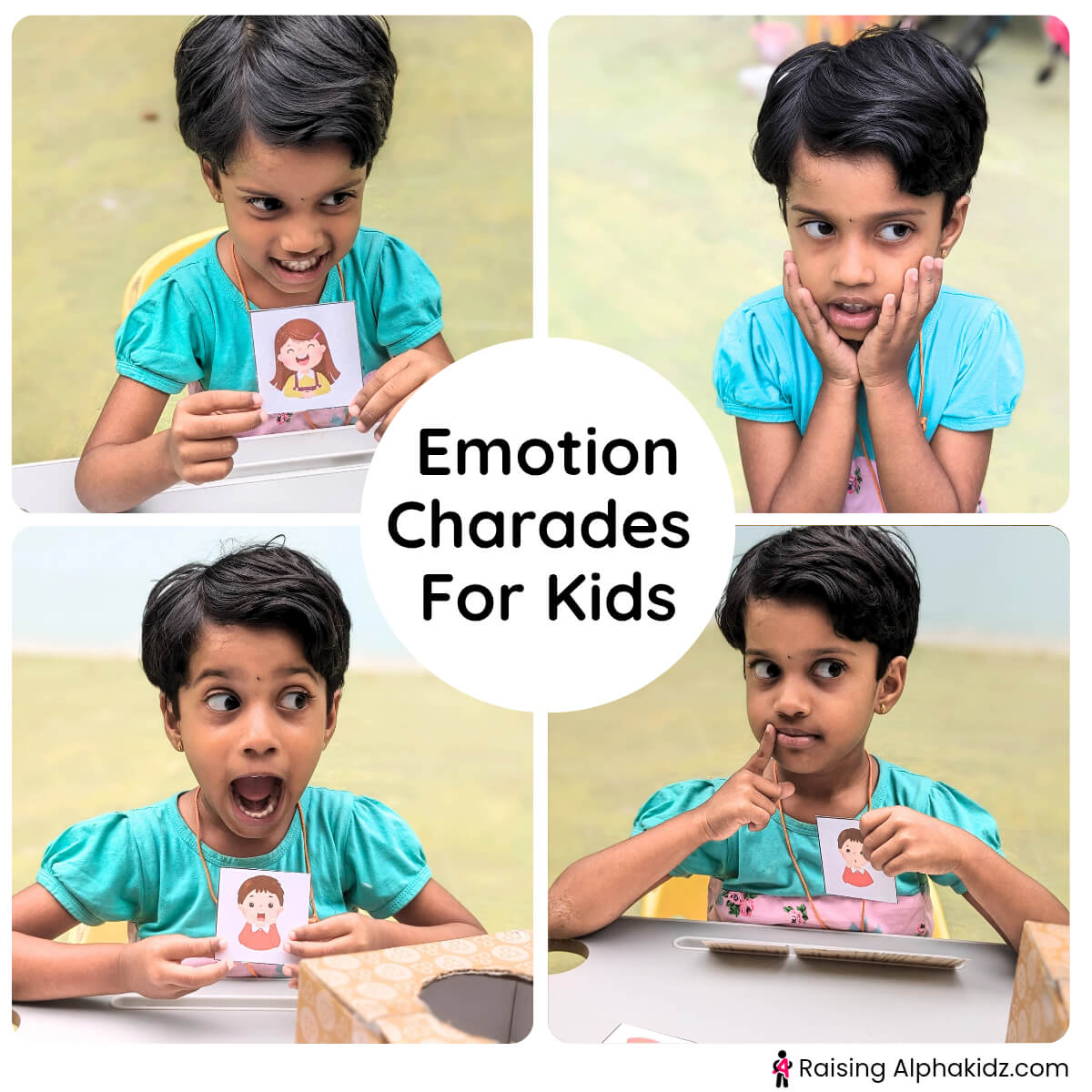
Emotions Charades is a creative, interactive activity where children use facial expressions and body language to act out different emotions. It is typically played using emotion flashcards, where each card features a cartoon illustration of a feeling such as happy, sad, angry, scared, excited, or surprised.
This activity helps children identify and express emotions in a safe and playful setting. It supports both social-emotional development and communication skills — making it an ideal tool for parents, teachers, and homeschoolers.
Craft Essentials
To set up this activity at home, the following materials are needed:
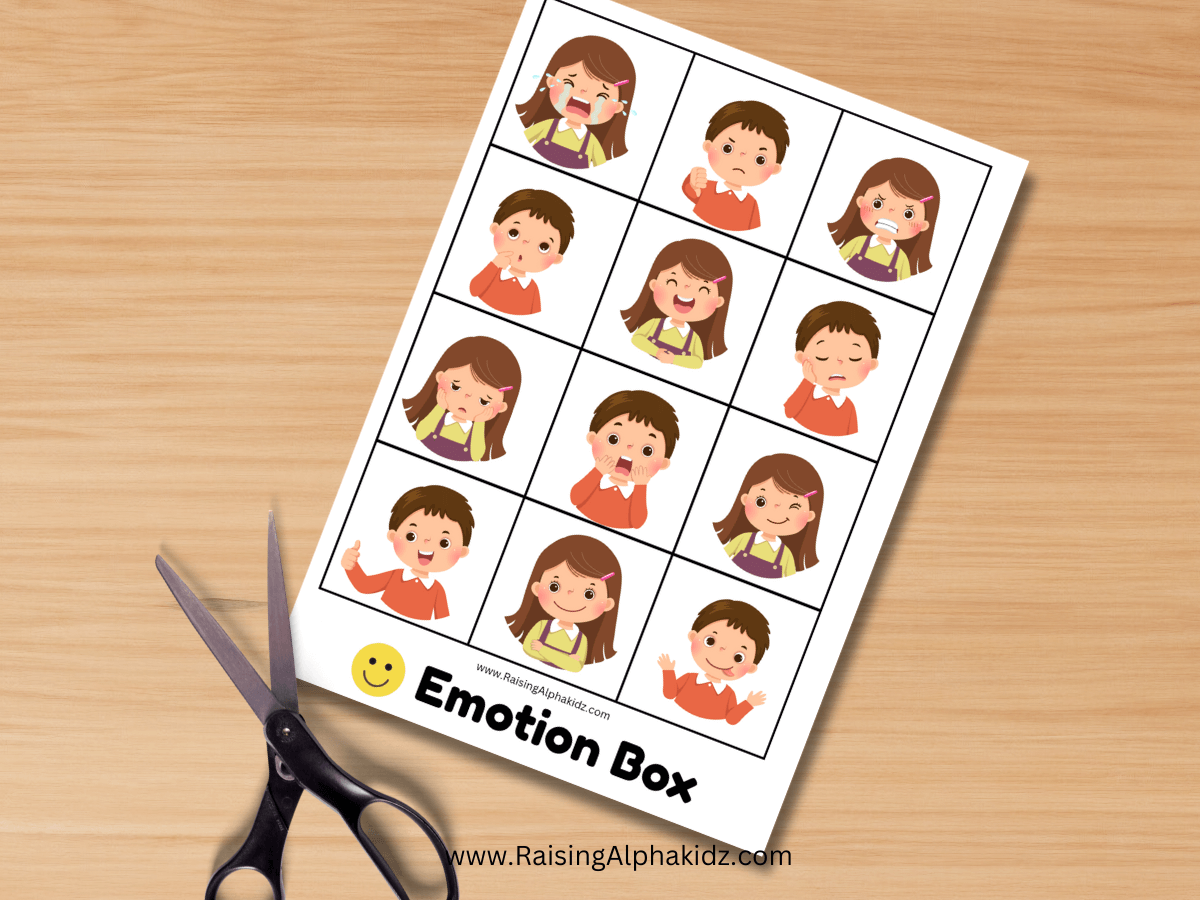
- A small cardboard box or container to hold the cards
- A set of emotion flashcards (Free Printables below)
- Thick paper or cardstock for durability
- An optional mirror for self-observation
- Open space for your child to act out freely
Emotion Charades – Rules to Play The Game
- Feel the emotion in your whole body, not just the face
- Think of a real or imaginary situation that brings that feeling
- Imagine being a character who experiences that emotion
- Use actions, sounds, or gibberish—without naming the emotion
- Take turns and allow each child to express the emotion for a few minutes before guessing
This playful activity helps children experience emotions deeply, making it easier for them to recognize, express, and manage feelings in real life.
How to Play the Emotions Charades Game
1) Prepare The Card: Prepare a set of cards with different emotions illustrated on them by downloading free printable.
2) Emotions Box: Place the cards in a box or shuffle them face down.
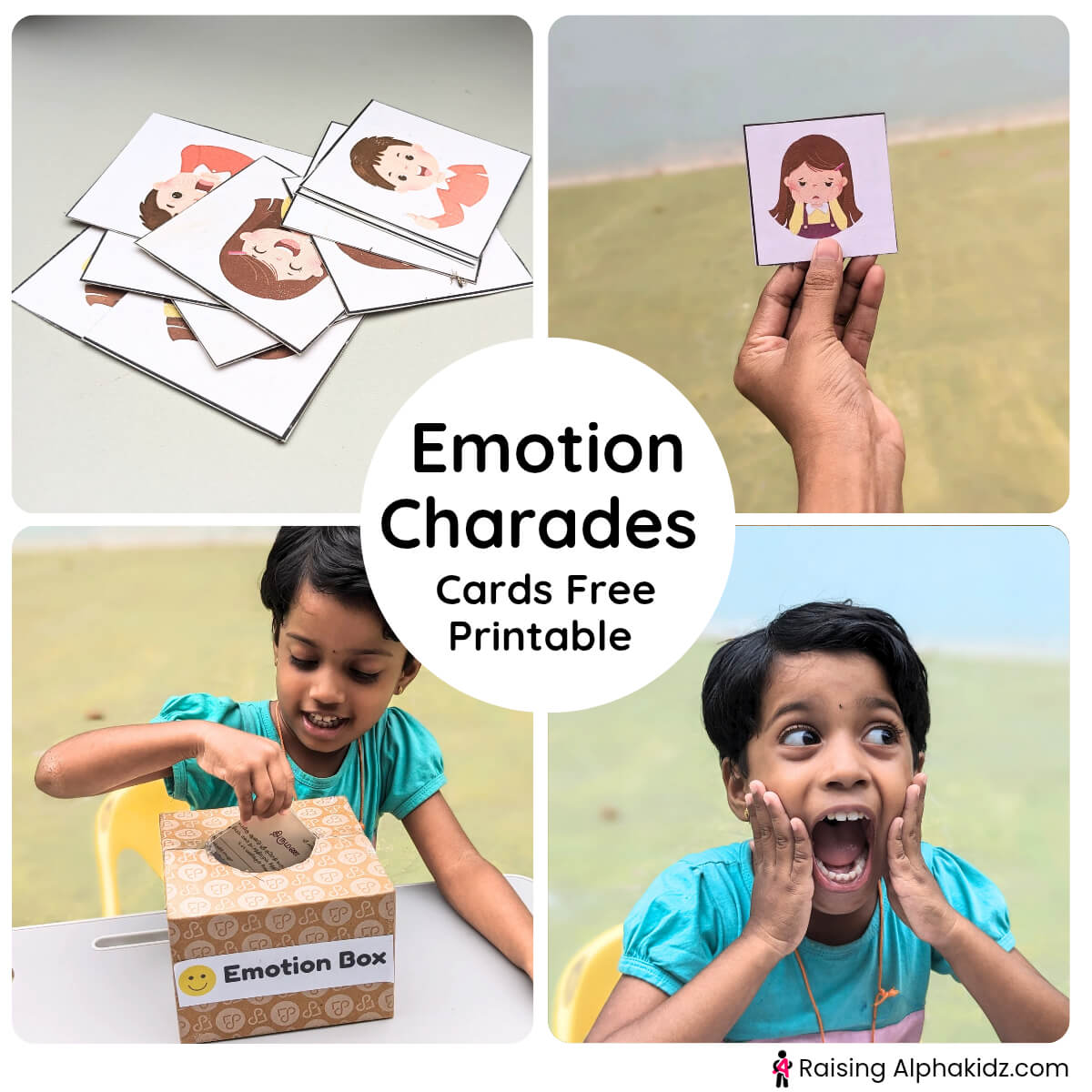
3) Pick The Card: Let the child picks one card from the emotion box.
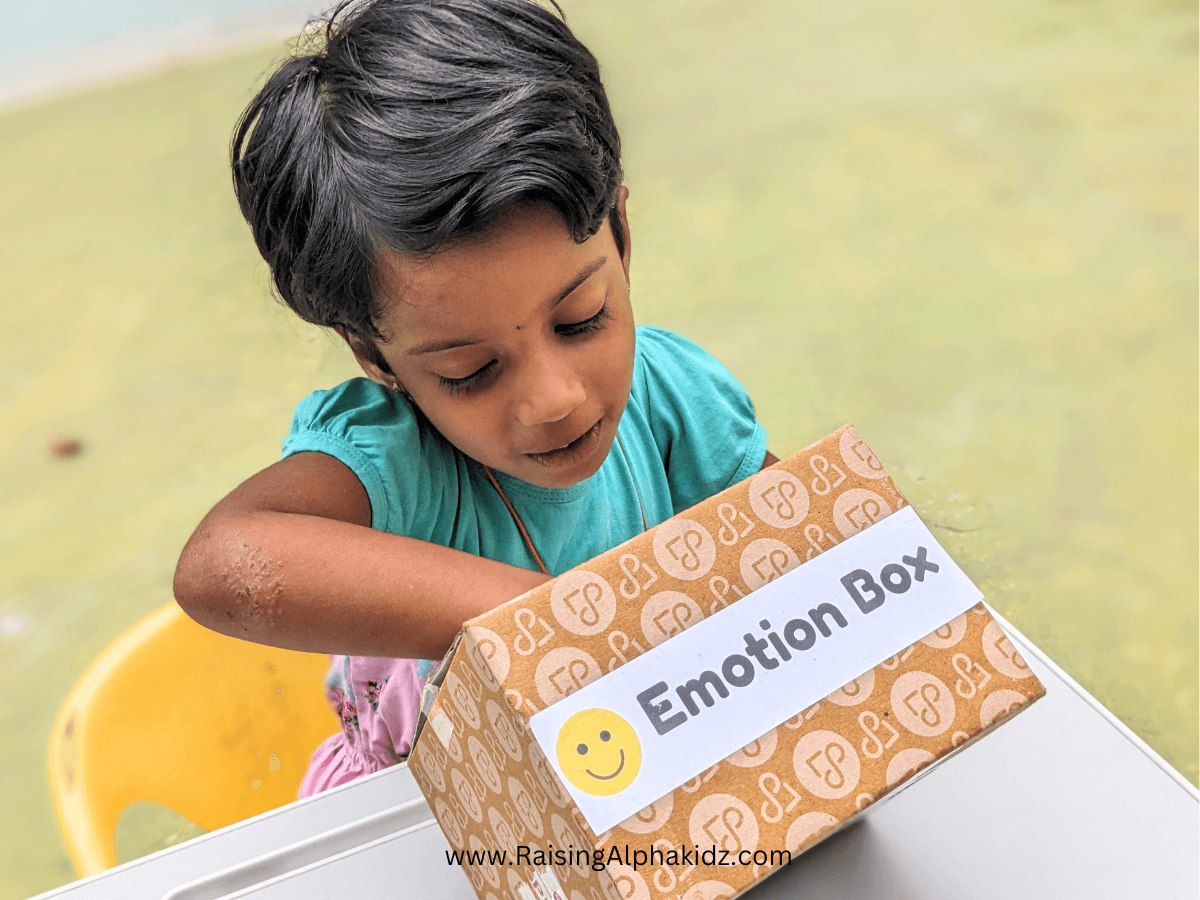
4) Act Out The Emotion: Without showing the card to others, the child acts out the emotion using only gestures and facial expressions — no words.

5) Guess The Emotion: The parent or other players guess the emotion.

6) Discuss The Emotion: Once guessed, a brief discussion can be encouraged to relate the emotion to real-life situations.

7) Ask Questions: For example, Ask questions like:
– “When do you feel this way?”
– “What makes someone feel like this?”

8) Pick The Next Card: After that, the child picks the next card and continues the game.
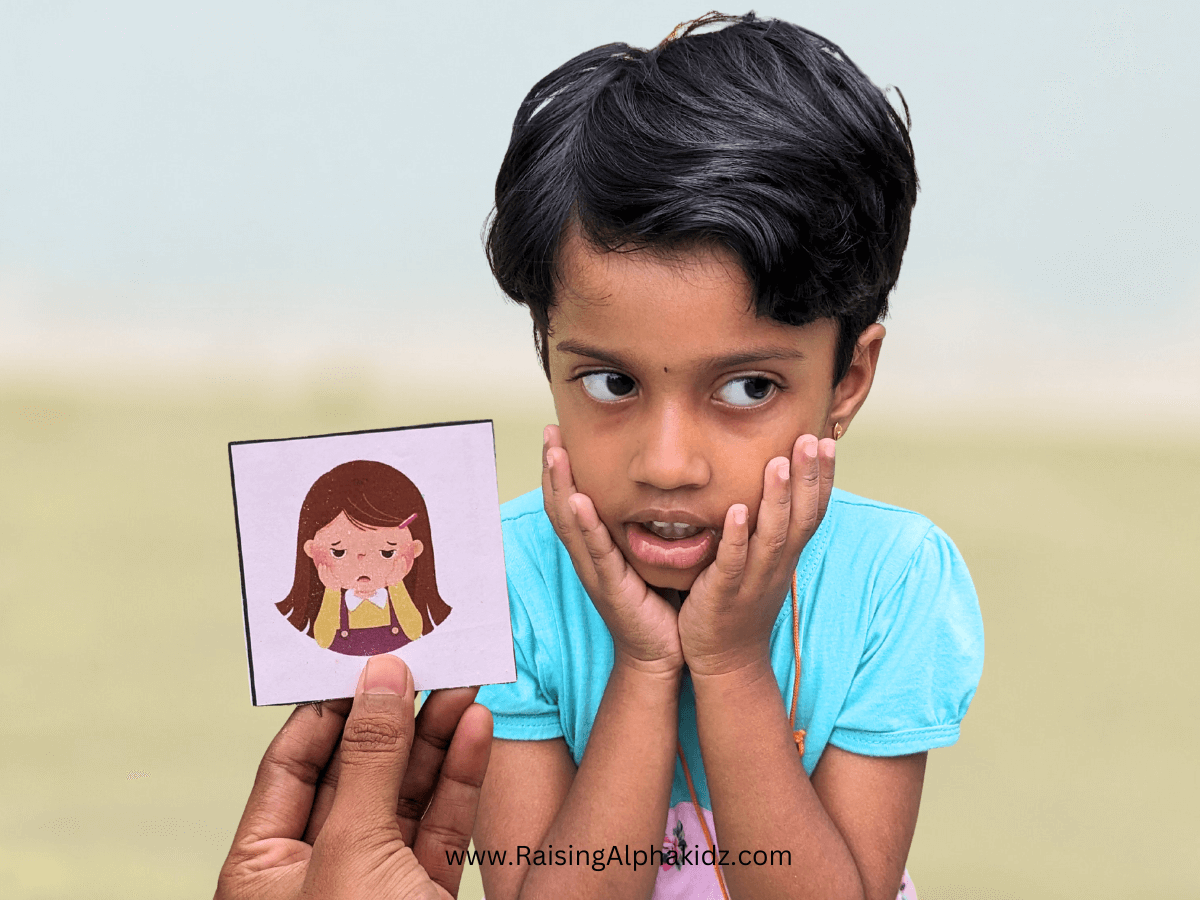
9) Continue The Game: The game can continue for as long as the child is interested, or until all cards are used.

10) Take Turns: You can also take turns, with adults acting and children guessing — this adds more fun and models expression for younger kids.
Educational Benefits of Emotion Charades
This activity supports multiple developmental areas:
1. Emotional Intelligence
Children become more aware of their own feelings and learn to recognize emotional expressions in others — an essential life skill.
2. Empathy Development
Understanding and acting out different emotions helps children build empathy toward peers and family members.
3. Social Skills
Charades requires turn-taking, observation, and respectful listening, all of which build foundational social behaviors.
4. Creative Thinking
Children use imagination and creativity to represent each emotion, encouraging abstract thinking and role-play skills.
5. Language Enrichment
While the game focuses on non-verbal expression, discussing emotions afterward expands emotional vocabulary.
Why Emotional Learning Matters in Early Education
Understanding emotions is a key component of Social-Emotional Learning (SEL). SEL has been shown to improve academic performance, classroom behavior, and emotional well-being.
Children who can identify emotions are better able to:
- Manage stress and frustration
- Resolve conflicts
- Express needs clearly
- Adapt to changes in the environment (home or school)
Incorporating emotion recognition activities like charades into early learning supports both cognitive and emotional growth. These soft skills form the foundation for success in relationships, academics, and life.
Download Emotions Charades FREE Printables
Extensions and Variations
To expand the activity, the following variations can be included:
- Add Situational Cards: Instead of just mimicking the emotions, include scenarios like “You lost your toy” or “You got a birthday gift” for children and ask them to show the cards that matches with scenarios.
- Make it Collaborative: Siblings or friends can play in teams, taking turns guessing and acting.
- Incorporate Drawing: After acting, kids can draw a face showing the same emotion to reinforce recognition.
In the middle of all the crafts, lessons, and games we do at home, this little box of emotions has become something truly special. It doesn’t need batteries, screens, or fancy tools — just your child’s expressive face, a safe space to act, and your attention.
Through every giggle, every exaggerated pout, and every wide-eyed surprise, our kids are learning something far deeper — how to understand themselves and others. And that, I believe, is the quiet foundation of a strong, kind, emotionally healthy human being.
If you’re a parent who loves to blend fun with meaning — who believes learning can be full of heart — try this simple yet powerful activity. You may just discover a new way to connect with your child, while helping them grow into emotionally aware, empathetic individuals.
Because sometimes, the most important lessons begin with a little pretend play… and a whole lot of love.