
The Earth Element: Grounding, Stability, and Our Connection to the Earth
What does the earth element mean, and why does it matter to us?
Especially for kids, earth isn’t just a play idea — its imbalance manifests up in real, observable ways in their behaviour. Understanding the earth element gives parents a simple, practical lens for recognizing why a child behaves the way they do — and which grounding activities will actually help.
In this guide, we’ll break down how kids connect to earth in three ways, walk through the three stages of grounding a child through nature (by age), and show you how to spot — and rebalance — earth imbalance in kids.
The Five Great Elements
Across many traditional systems of thought, our bodies, the universe, and all living and non-living things — every inhabitant of the world — are composed of five great elements: Earth, Water, Fire, Air, and Space.
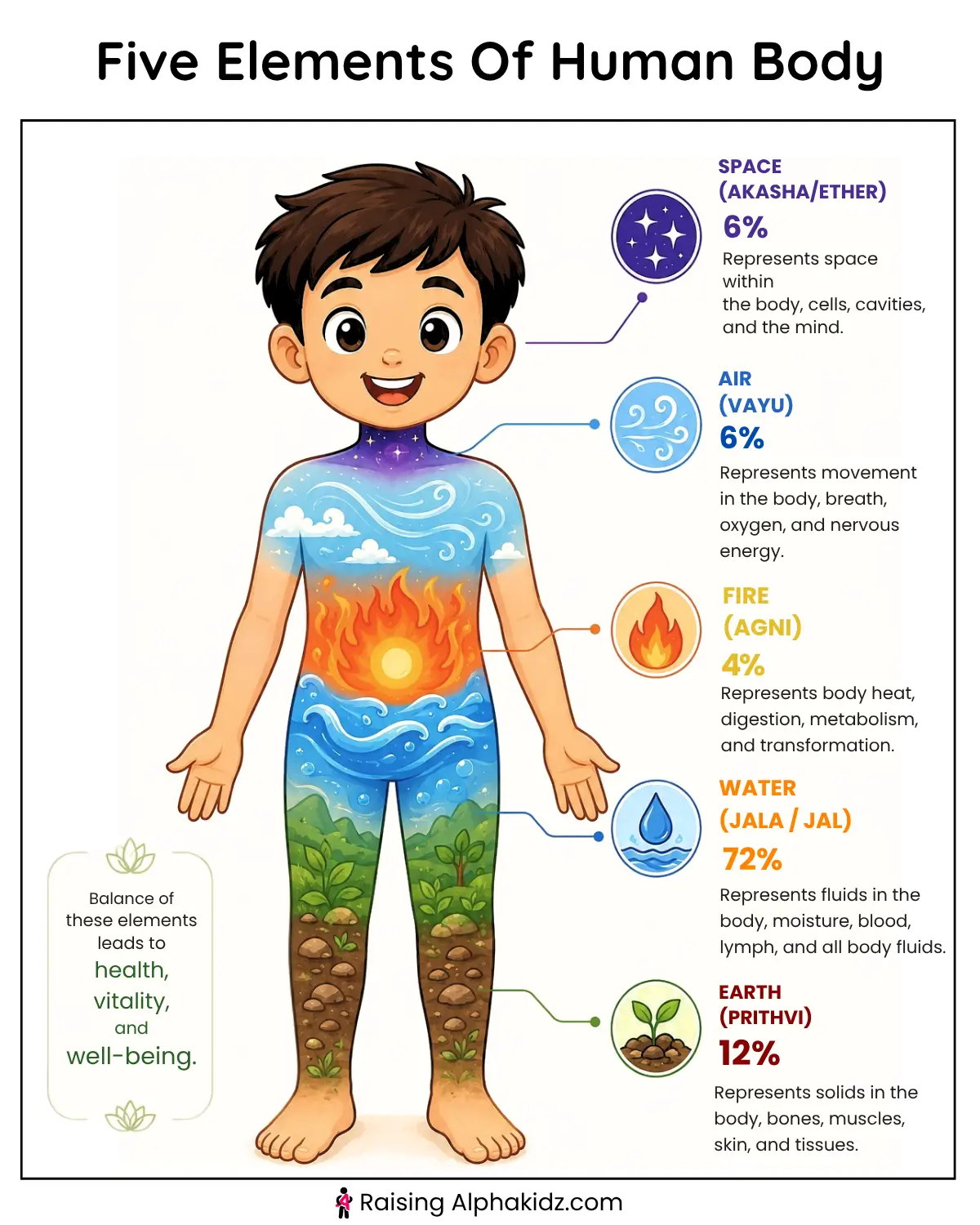
Among them, Earth is the foundation or base component that gives stability to the world. When we look at the idea of earth not simply as the soil beneath our feet, but as something reflected in the world around us and within the human body, it offers an interesting way to think about health, balance, and everyday life.
What is Earth Element?
Earth isn’t just the ground we walk on — it’s a thread that runs through our environment, our bodies, and our energy.
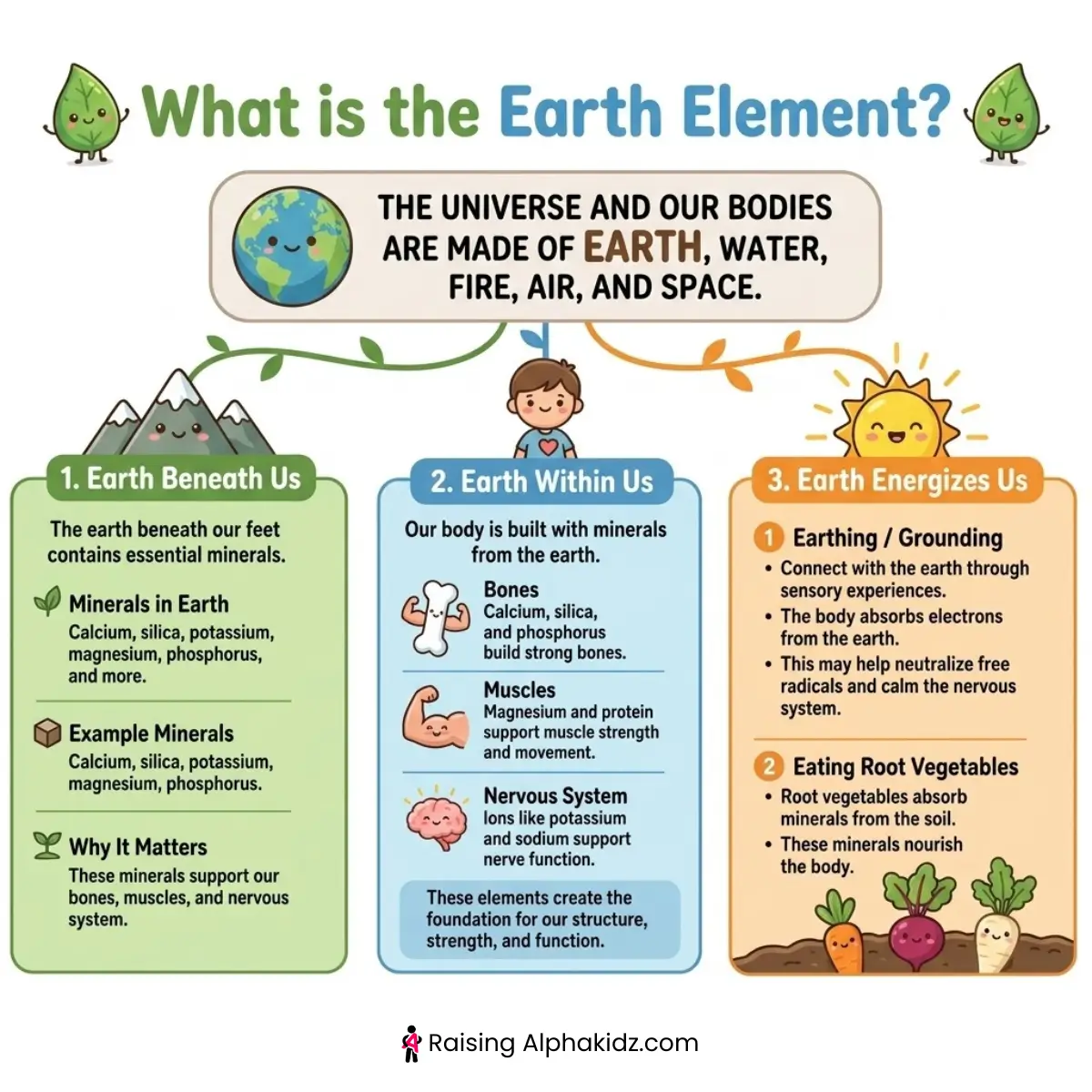
Thus, we humans connect to earth in three ways:
- Earth Beneath Us
- Earth Within Us
- Earth Energizing Us
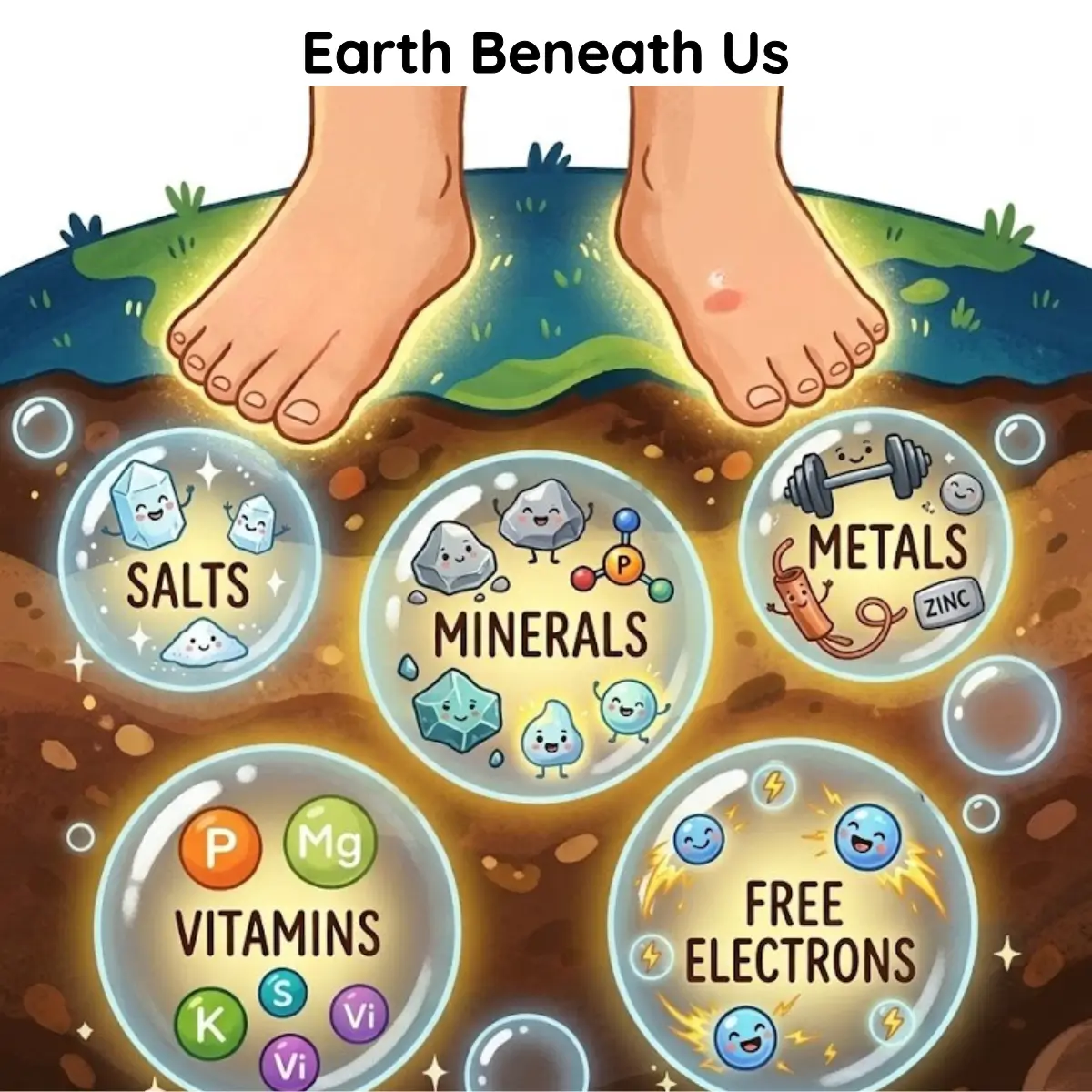
Earth Beneath Us
The earth beneath our feet contains minerals, salts, ions that are fundamental to life. Minerals such as calcium, silica, potassium, magnesium, and phosphorus are found throughout the natural environment and also play important roles in the human body.
Our bones, for example, depend heavily on minerals such as calcium and phosphorus for their structure. Muscles and the nervous system also rely on minerals and electrolytes to function properly.
In this sense, we are not separate from the earth. The materials that make up our bodies ultimately come from the natural world.
Earth Within Us
The connection becomes even more interesting when we consider the human body.
Our bones, muscles, cells,blood and nervous system all depend on minerals and nutrients. Calcium and phosphorus contribute to bone structure, while magnesium and other electrolytes support normal muscle and nerve function.
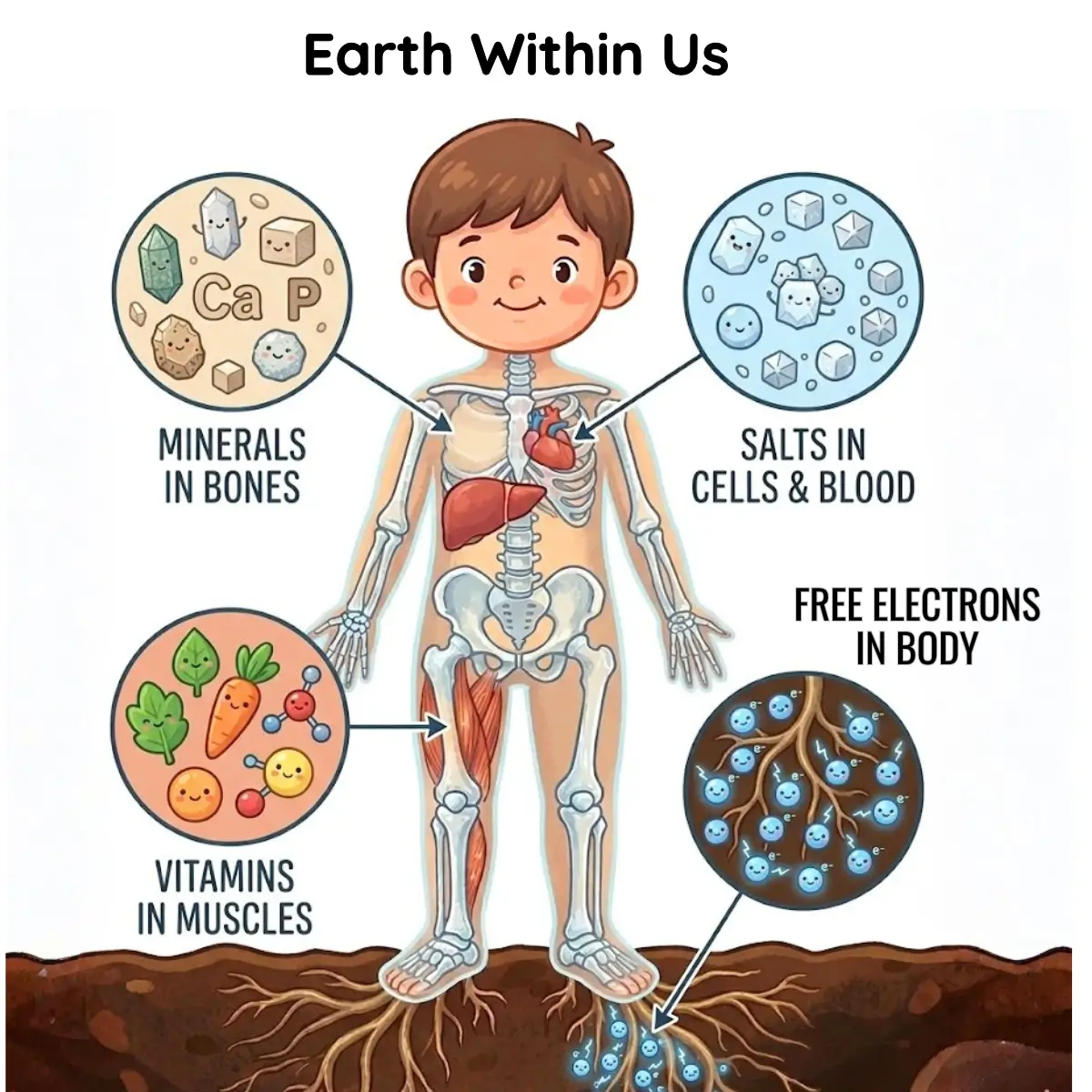
Thinking of the body as carrying the “earth element” can therefore be understood as a metaphor for our physical foundation: our bones give us structure, our muscles give us strength, and our nervous system allows us to sense, respond and belong to the world.
The earth element represents the parts of us that create a sense of foundation, stability and belonging.
Earth Energising Us
Grounding Energy
Another common idea associated with the earth element is grounding, sometimes called earthing.
Grounding practices involve deliberately connecting with the natural environment—for example, just like electrical circuit needs grounding to neutralize the circuit, human body grounds it’s free radicals through walking barefoot on grass, soil, or sand, or simply spending time outdoors and becoming more aware of physical sensations.
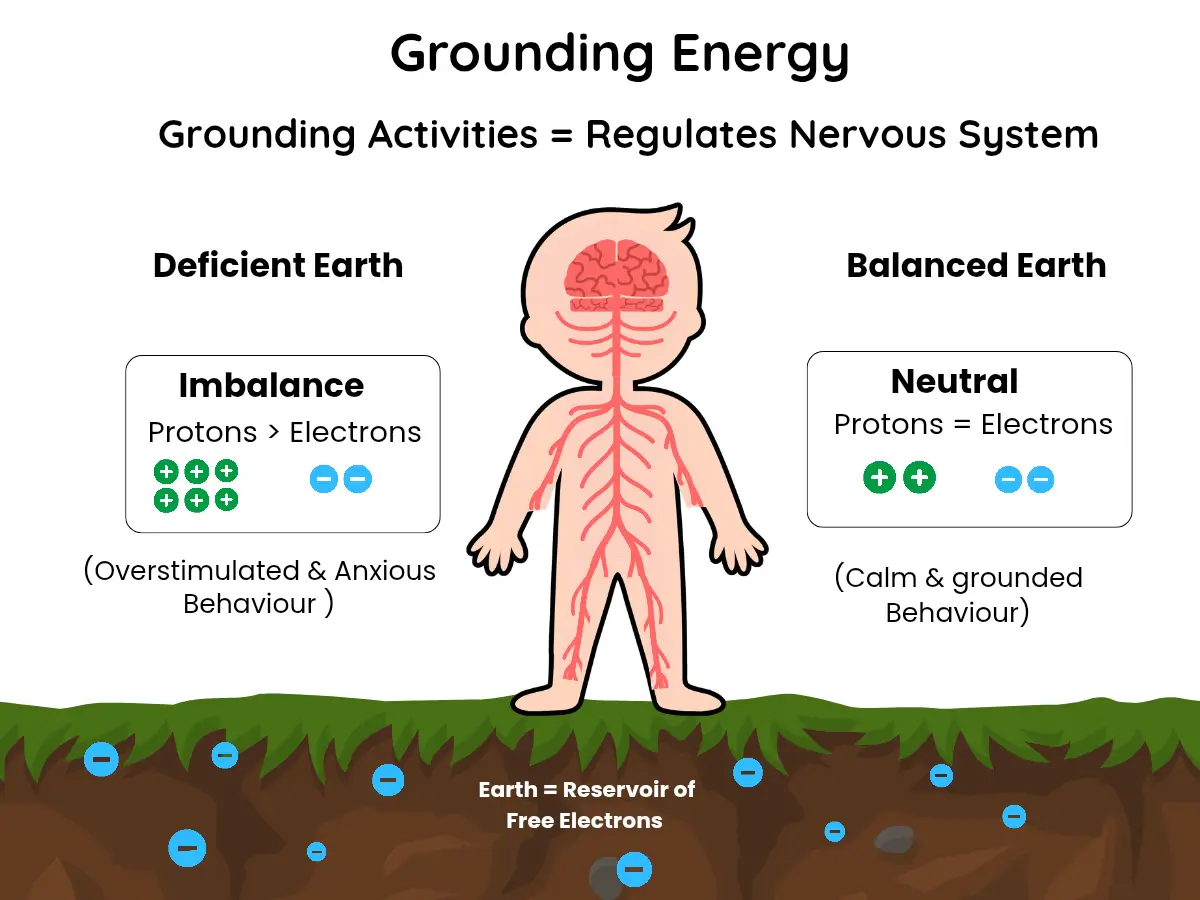
There are many reasons why spending time in nature can feel calming. Slowing down, paying attention to our surroundings, moving our bodies, and taking a break from screens and daily pressures can all contribute to a greater sense of calm.
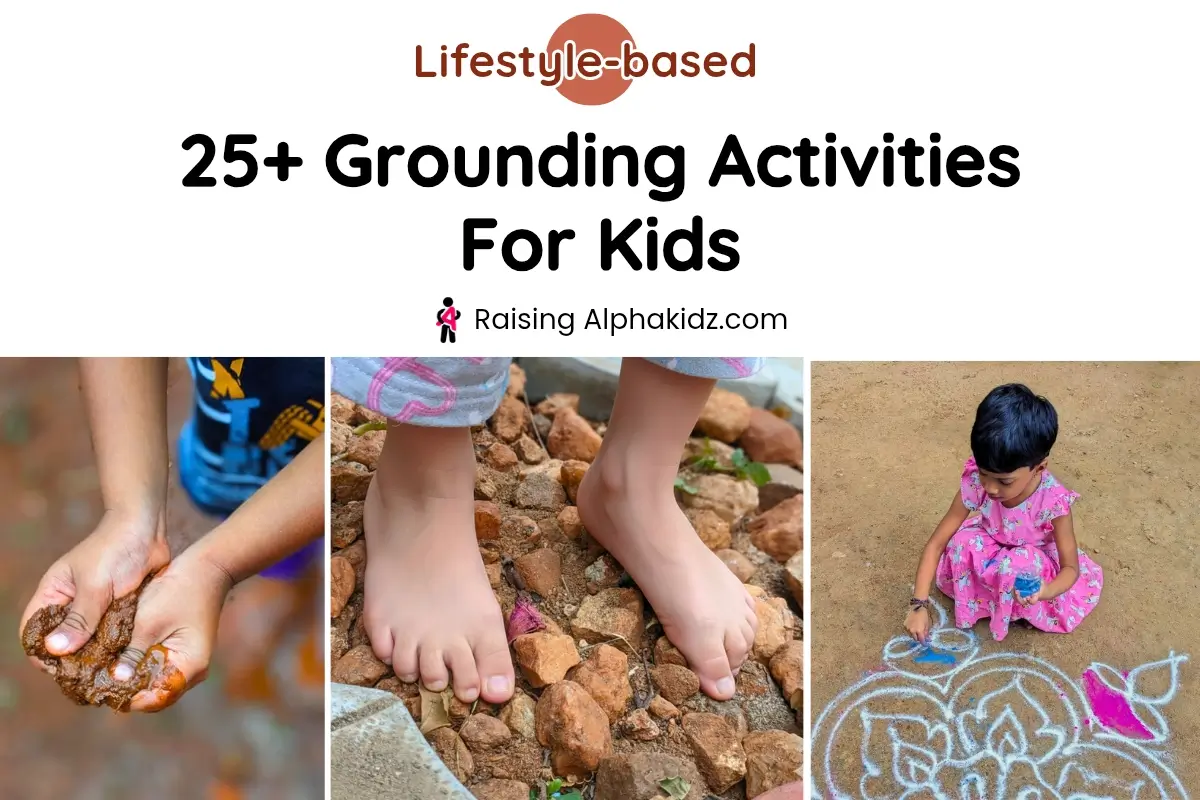
Related Posts: 25+ Grounding Activities For Kids | Manage Anxiety & Stress
Energy Through Eating From the Earth
Food is another direct connection between us and the earth.
Plants grow absorbing nutrients from earth and fruits, vegetables and all other whole foods grow from soil which provide a wide variety of nutrients and minerals to to human body. Eating a diverse, balanced diet allows us to obtain the nutrients our bodies need for normal grounded functioning.
The symbolic connection is simple: the earth nourishes us, and we are sustained by what grows from it.
How Does the Earth Element Shows Up?
If we bring these ideas together, the earth element can represent:
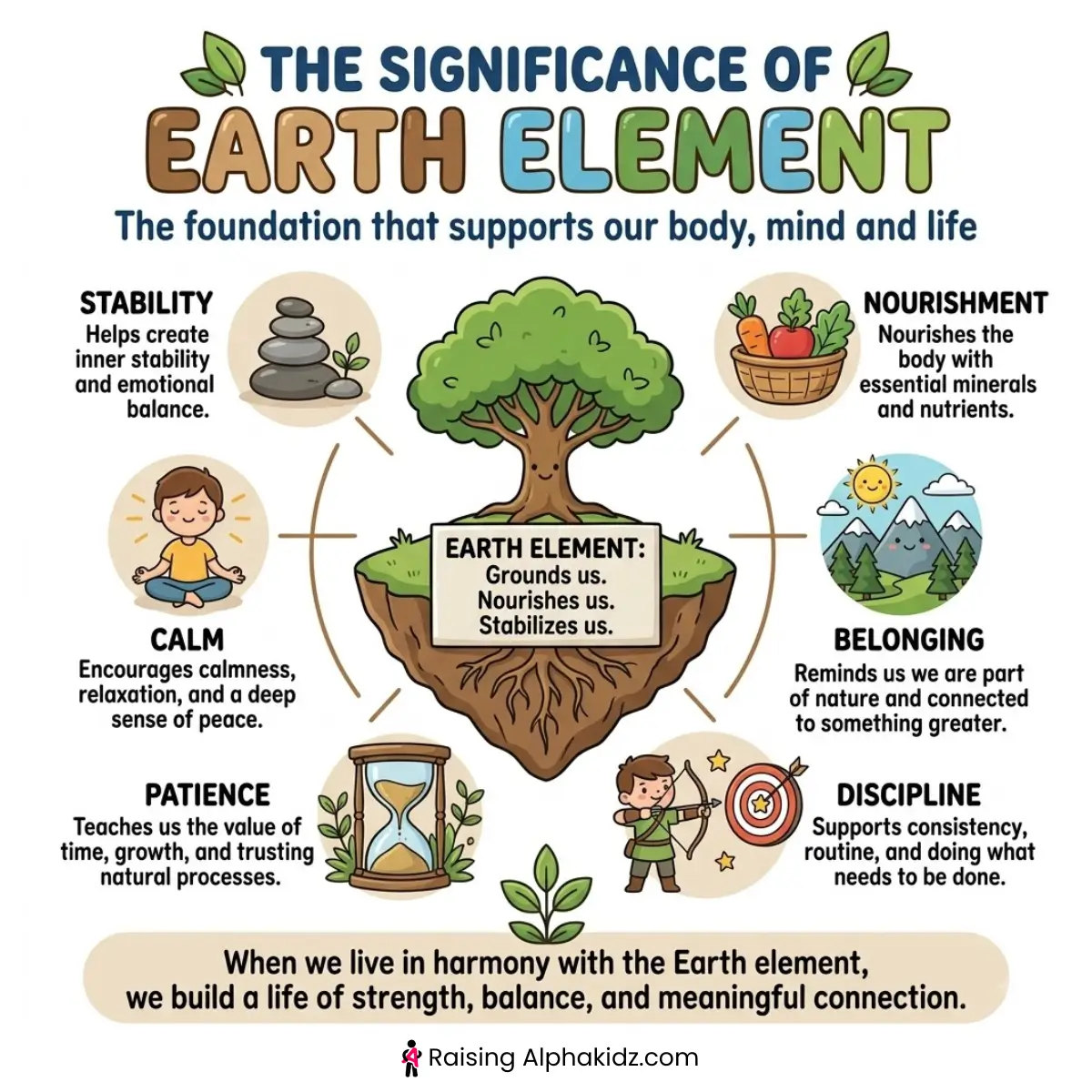
- Stability — having a strong foundation.
- Structure — the physical framework that supports us.
- Calm — creating space to slow down and settle.
- Belonging — remembering that we are part of nature rather than separate from it.
- Patience — allowing things to develop gradually.
- Discipline — creating routines and consistency.
- Humility — recognizing our connection to something much larger than ourselves.
These qualities can influence how we approach everyday life.
When we feel grounded, we may be more likely to create routines, make thoughtful decisions, remain patient, and respond rather than react. A sense of belonging can also help us feel more connected to ourselves and to the people and environment around us.
Bringing the Earth Element Into Everyday Life
You don’t need to adopt a particular ideological belief to explore the qualities associated with earth.
You might simply:
- Spend time in nature: Walk through a park, sit beneath a tree, garden, or take a quiet walk without your phone.
- Create stable routines: Regular sleep, nourishing meals, movement, and moments of rest can provide structure to the day.
- Eat nourishing whole foods: Focus on eating nutritious and balanced diet.
- Practice patience: Like nature, meaningful growth often happens gradually.
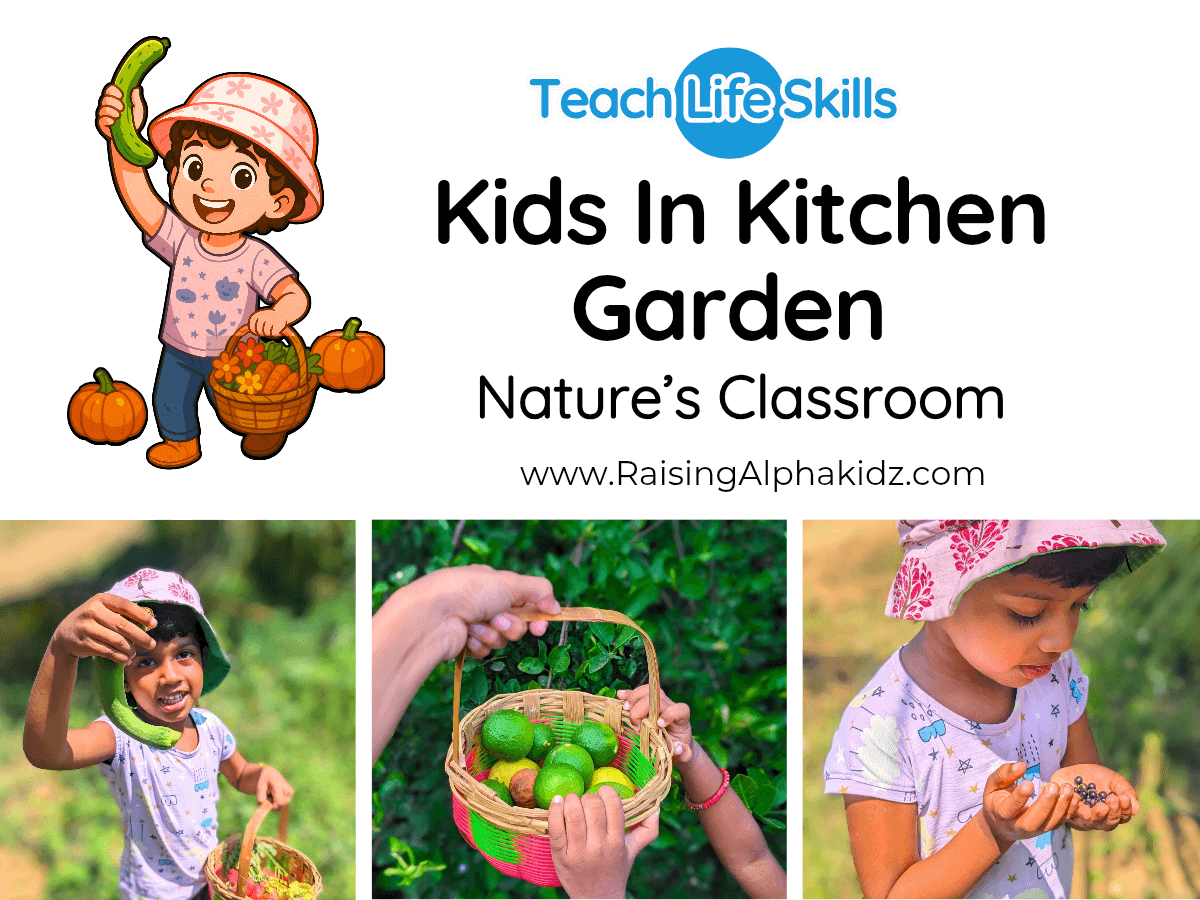
Related Posts: In The Age Of AI, Why Kids Need A Kitchen Garden
The Deeper Meaning of Earth
Ultimately, the earth element can be viewed as a reminder of Belonging.
We are made from the natural world, nourished by it, and dependent on it. Our bodies require minerals and nutrients, our minds benefit from rest and stability, and our lives are shaped by the environments in which we live.
Whether you approach the earth element as a traditional symbol, a ideological concept, or simply a metaphor for grounded living, its message is powerful:
Build a strong foundation through belonging. Stay grounded through connection with nature. Live with patience by creating stability. And remember where you come from.
The more grounded we become, the more space we may create for calmness, clarity, discipline, and a genuine sense of belonging.
Earth Energy Creates Belonging
There’s a simple equation at the heart of how children build their sense of security in the world: Earth Energy = Belonging.
Three Stages of Grounding a Child Through Nature
Long before a child can explain why a walk in the mud feels good, or why stacking blocks into a fort feels satisfying, their nervous system is already doing the work of connecting them to the ground beneath them — literally and figuratively.
This is the idea behind a three-stage framework for reinforcing a child’s relationship with the earth as they grow.
The Three stages of reinforcing earth element in kids can be done through
- Sensory Exploration
- Intent Craftmanship
- Building Planned Structure
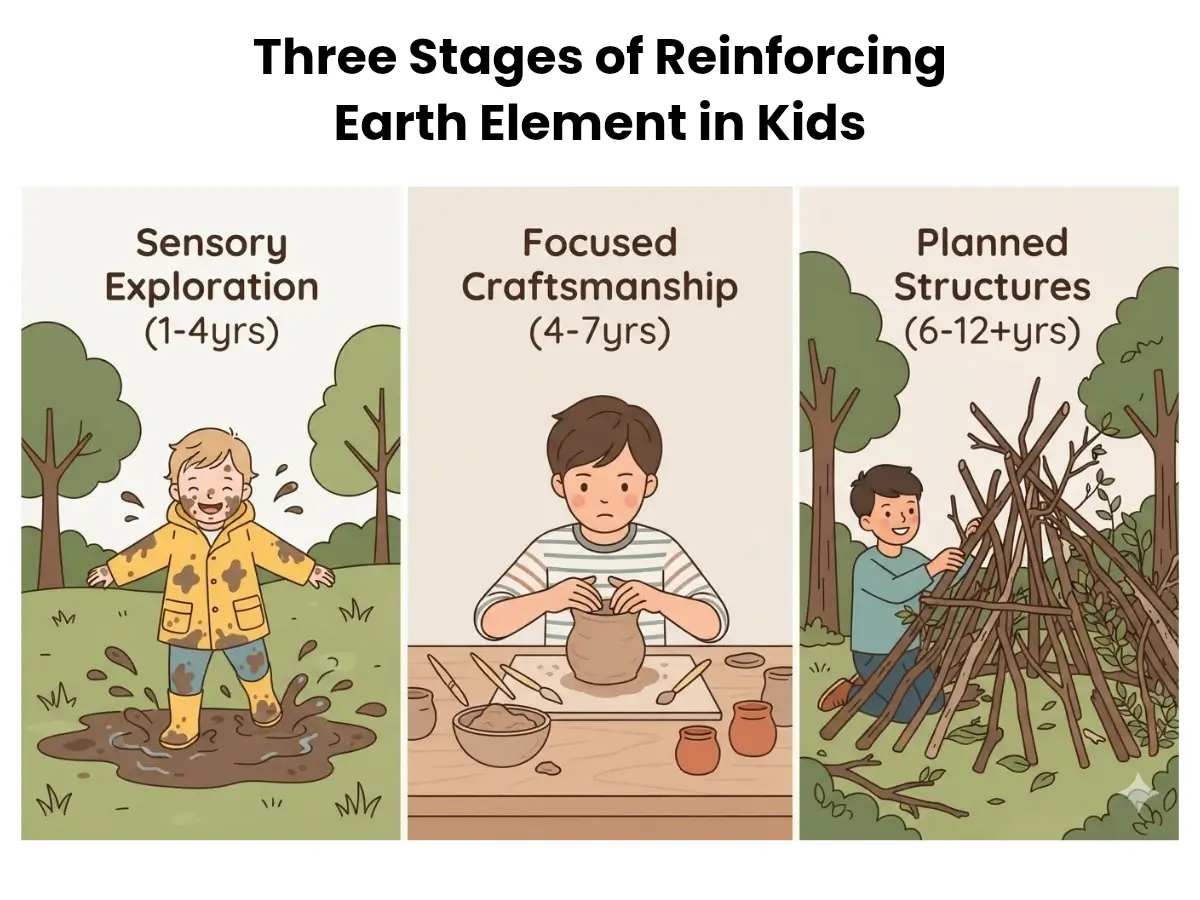
Each stage builds on the one before it, moving a child from feeling the earth, to shaping it with intention, to building systems upon it with purpose.
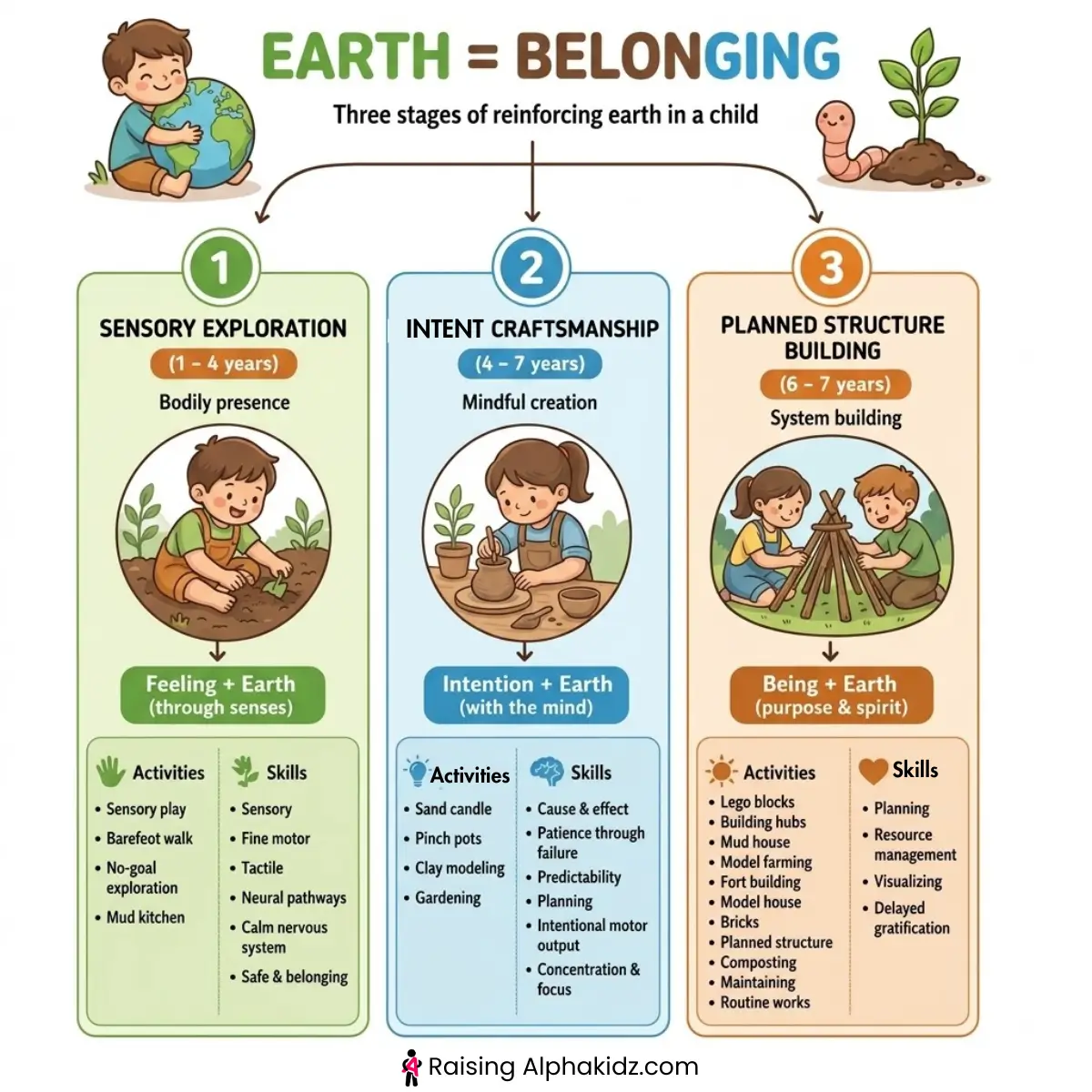
Stage 1: Sensory Exploration (Ages 1–4) — Feeling + Earth Energy
The foundation of this framework is bodily presence. At this age, connection to the earth isn’t conceptual — it’s felt through the senses. A toddler doesn’t need a plan or a goal; they need permission to touch, squish, and wander.
Activities:
- Sensory play
- Barefoot walking
- No-goal, open-ended exploration
- Mud kitchens
Skills developed:
- Sensory processing
- Fine motor coordination
- Tactile awareness
- Neural pathway development
- A calmer nervous system
- A foundational sense of safety and belonging
At this stage, the earth is not something to be shaped — it’s something to be felt. The unstructured, judgment-free nature of this exploration is what allows a child’s nervous system to settle and register the ground as a safe place to exist.
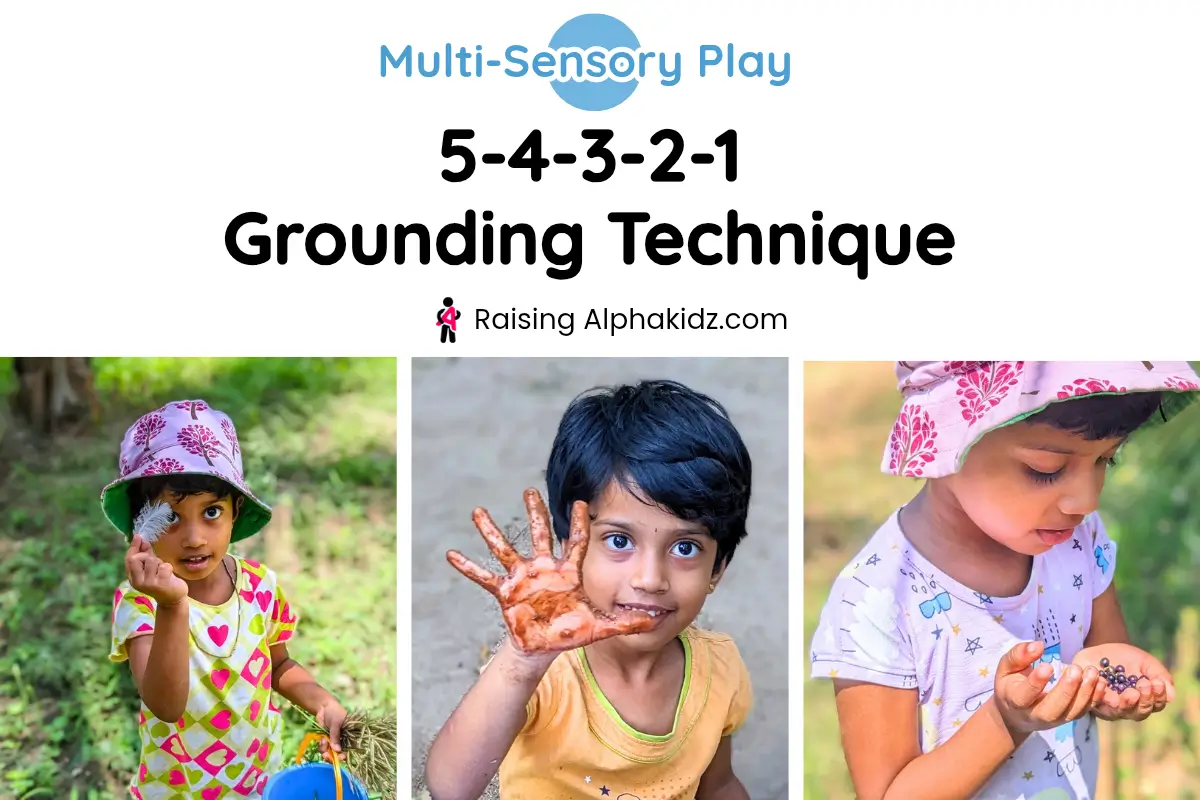
Stage 2: Intended Craftsmanship (Ages 4–7) — Intention + Earth Energy
As a child’s mind develops alongside their senses, exploration starts to gain direction. This is mindful creation — the shift from simply feeling materials to intentionally shaping them.
Activities:
- Building sandcastles
- Making pinch pots
- Clay modeling
- Gardening
Skills developed:
- Understanding cause and effect
- Patience through failure
- Tolerance for unpredictability
- Early planning ability
- Intentional motor output
- Concentration and focus
This stage introduces something new: effort with a intention. A sandcastle can collapse. A pinch pot can crack. These small failures, repeated in a low-stakes, tactile context, are where a child begins to build resilience — learning that intention doesn’t always guarantee outcome, and that’s okay.
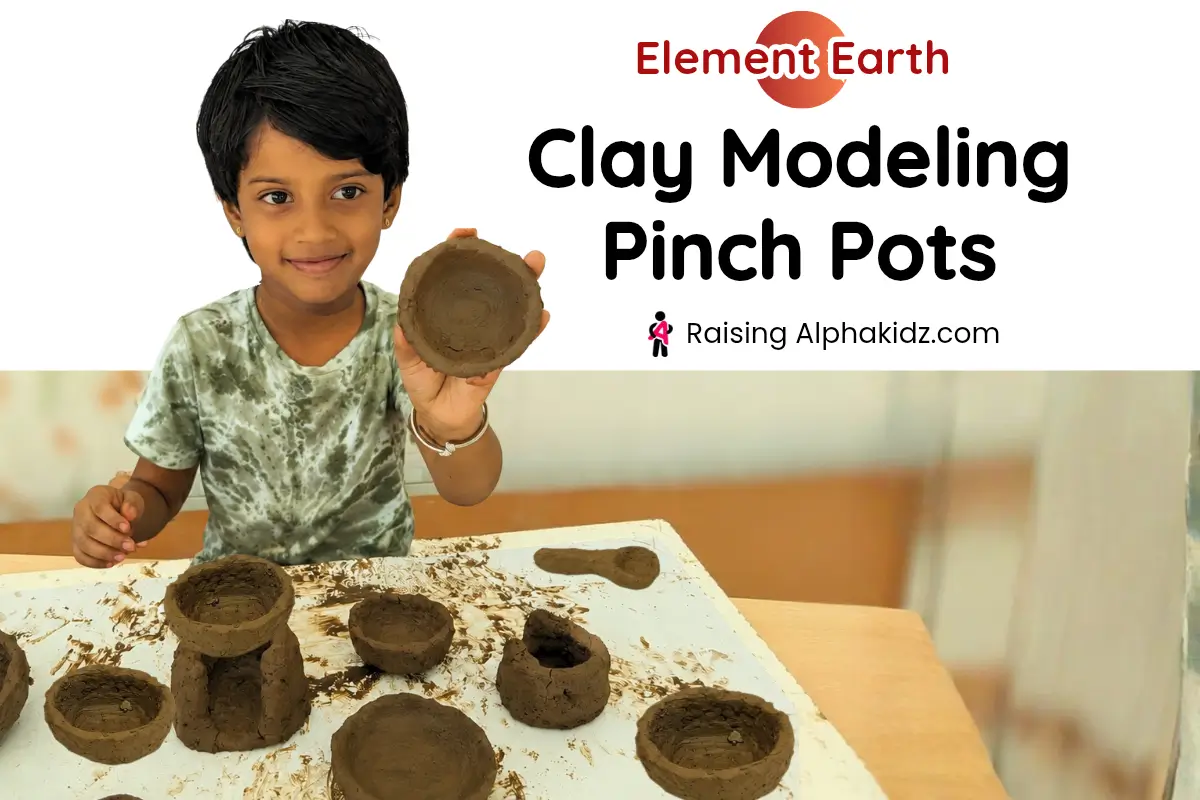
Related Posts: How To Make Pinch Pots With Kids | Easy Clay Modeling Guide
Stage 3: Planned Structure Building (Ages 6–7) — Being + Earth Energy
By the final stage, the relationship with earth becomes one of system building. This is where purpose enters — what the framework creates a path to ultimate manifestion. The child isn’t just creating an object; they’re constructing something that reflects their own sense of being in relation to the world, creating something that endures as a symbol of stability.
Activities:
- Lego and building blocks
- Mud houses
- Model forming
- Fort building
- Model house bricklaying
- Planned gardening, composting, and maintenance routines
Skills developed:
- Planning
- Sequencing
- Foresight
- Visualization
- Delayed gratification
This stage asks more of a child than the previous two — not just patience, but foresight. Maintaining a compost pile or a garden bed over weeks requires holding a future outcome in mind and taking consistent, routine action toward it. This is where a child starts to internalize responsibility, not as a chore, but as an extension of their own purpose.
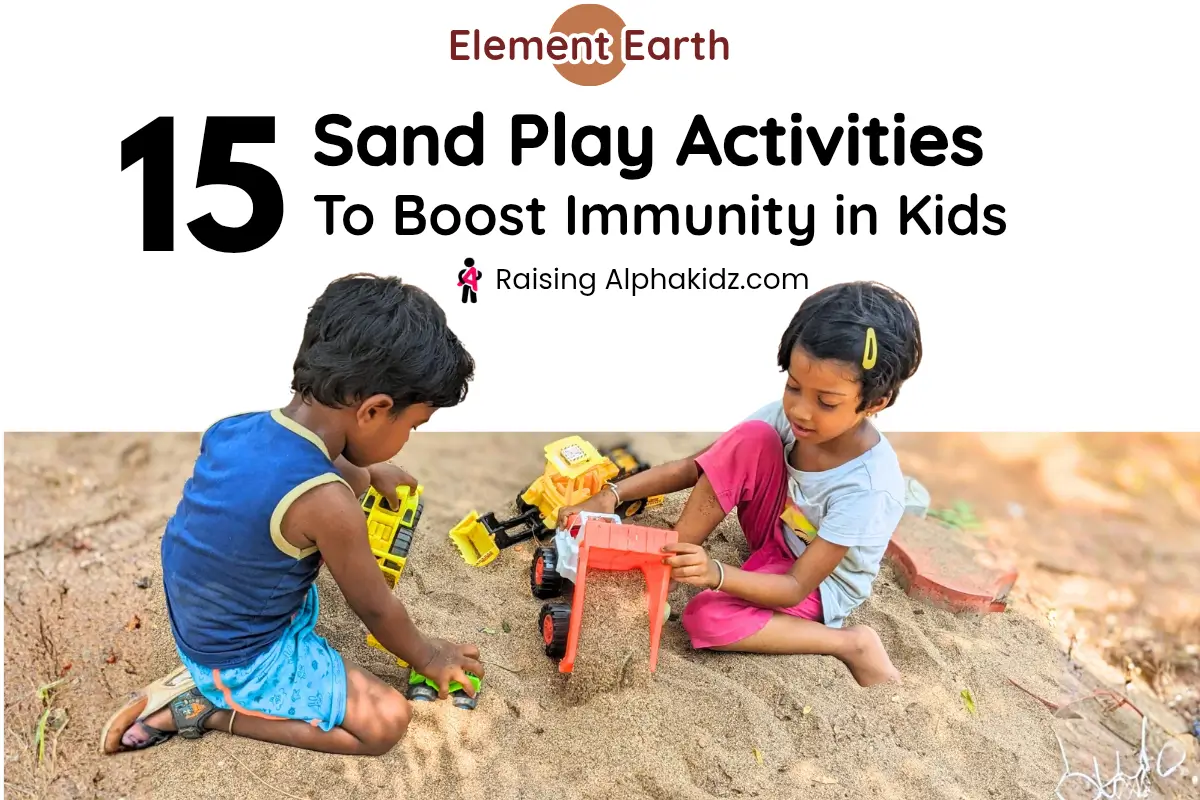
Why This Progression Matters
Taken together, these three stages trace a child’s evolving relationship with the earth — and with themselves:
- Senses → feeling the earth (safety, presence)
- Mind → shaping the earth (intention, patience)
- Purpose → building on the earth (foresight, responsibility)
Each stage isn’t a replacement for the last — it’s layered on top of it. A seven-year-old building a mud house is still relying on the sensory groundwork laid at age two.
When we let children move through these stages naturally, unrushed, we’re not just teaching motor skills or patience. We’re reinforcing something much deeper: the felt sense that they belong here, on this earth, and that they have the capacity to shape it with care.
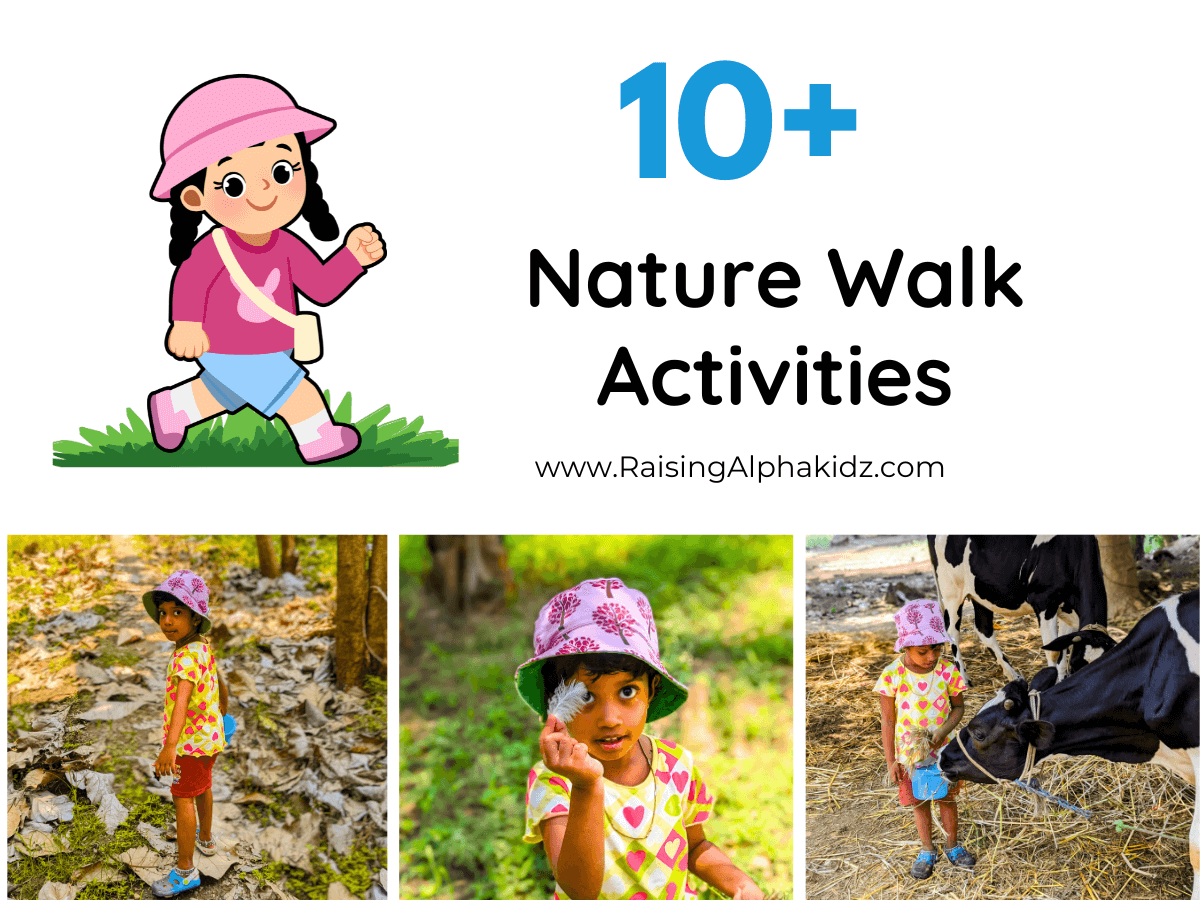
Related Posts: Nature Walk Activities
Earth Energy Imbalance
Recognizing Deficient and Excessive Earth Energy in Children
If Earth represents belonging, groundedness, and connection to the body and the present moment, then an imbalance in this element shows up in very recognizable — and very different — ways depending on which direction it tips.
A child can either have too little Earth or too much Earth, is not a syndrome or disease but a inherited elemental composition of human body. Each comes with its own set of signs and its own path back to balance.
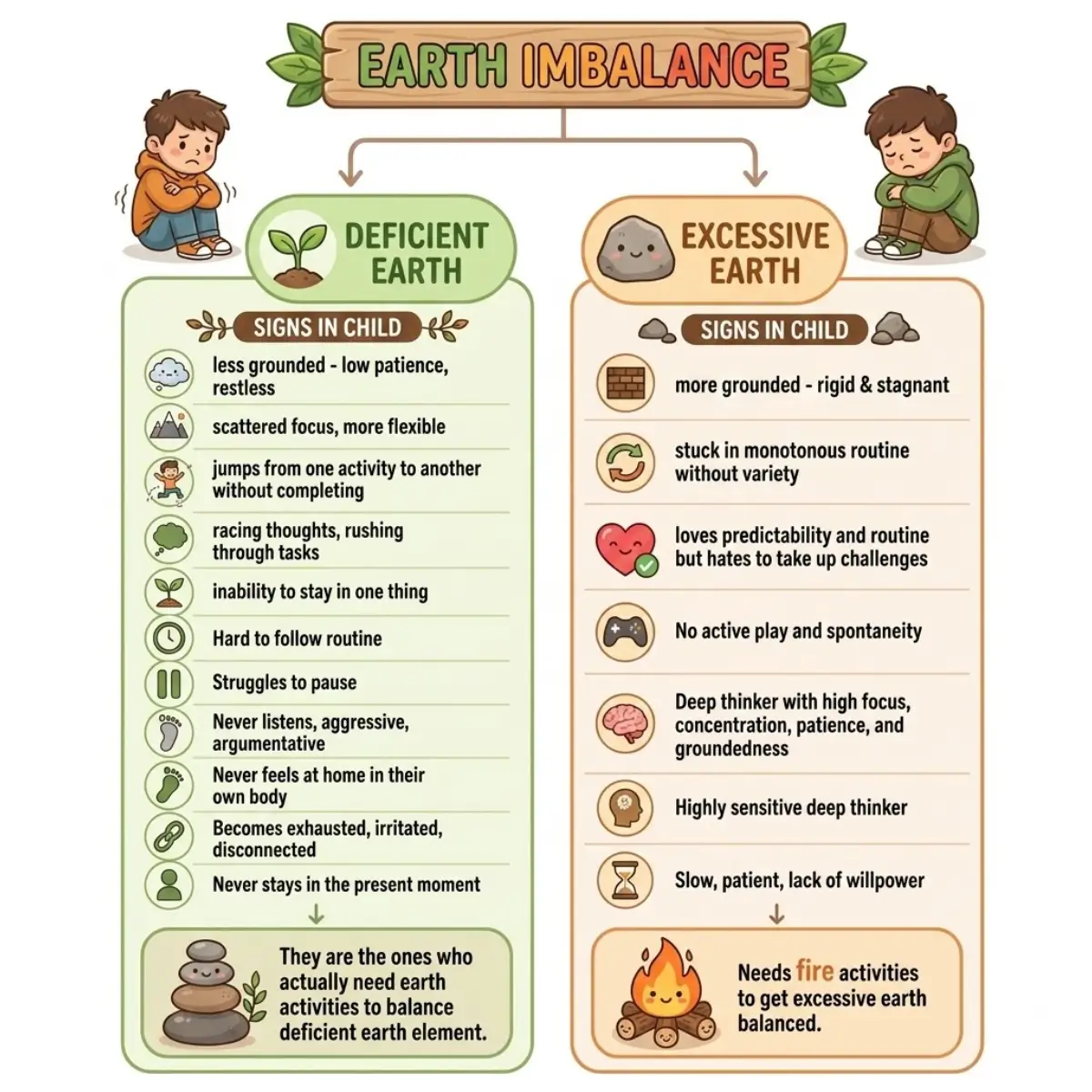
Deficient Earth Energy
A child with deficient earth manifest as a behavioural pattern and temperament in child. They struggle to feel settled in their own body and in the present moment, because deficient earth will leads to excessive air. Their body is lacking earth energy, due to excessive fast moving air energy— which needs grounding.
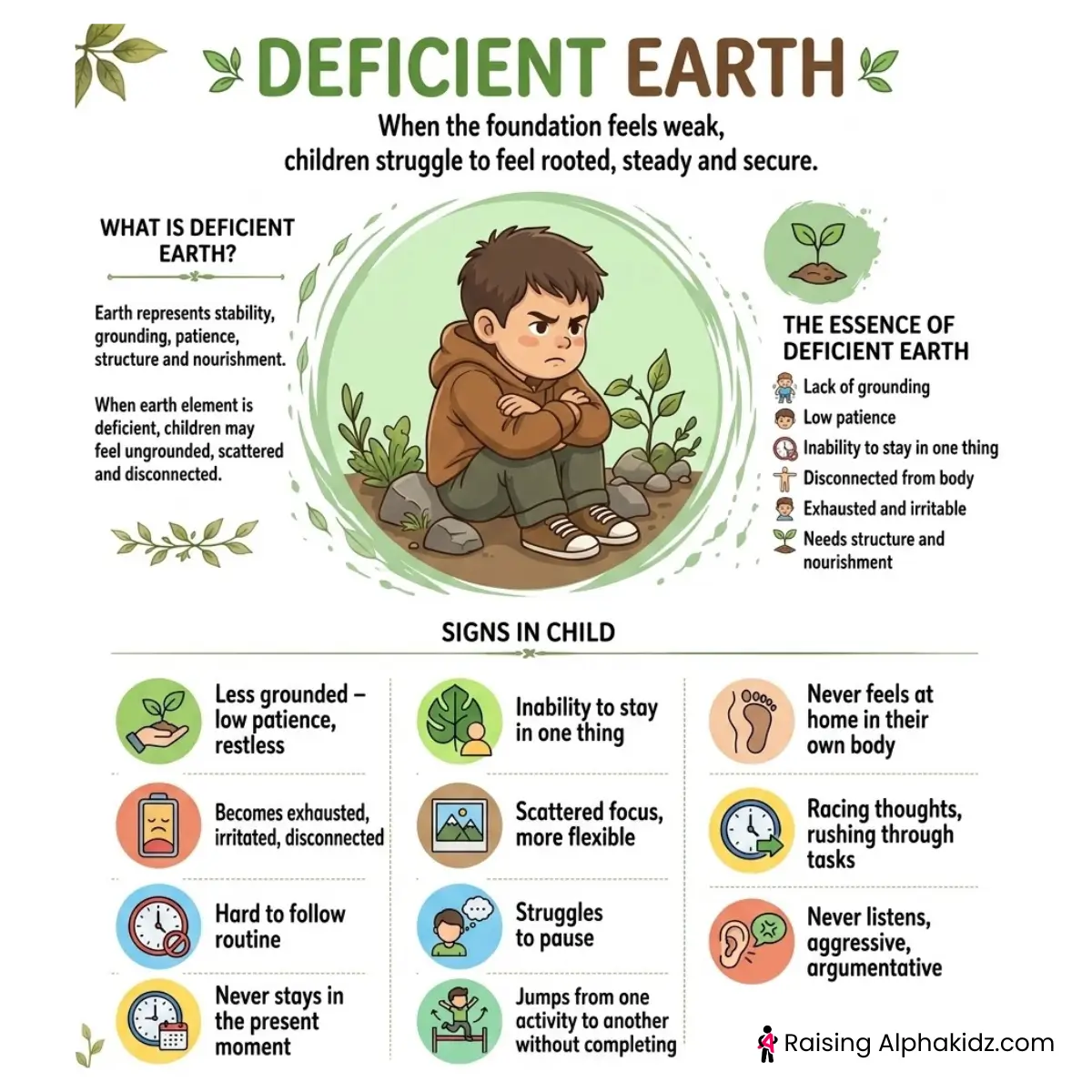
Signs in the child:
- Less grounded, low patience, restless
- Scattered focus, jumps quickly between ideas
- Moves from one activity to another without finishing
- Racing thoughts, rushes through tasks
- Inability to stay with one thing for long
- Difficulty following routine
- Struggles to pause
- Doesn’t listen well; can be aggressive or argumentative
- Never feels at home in their own body
- Becomes exhausted, irritated, and disconnected easily
- Rarely stays present in the moment
These children are often mistaken for simply being “high energy” or “distractible,” but underneath the restlessness is a nervous system that hasn’t found its footing. Ironically, this is exactly the profile of a child who most needs — and often most resists — slow, grounding, sensory-rich earth activities. Barefoot walks, mud kitchens, gardening, and unhurried tactile play aren’t a punishment for this child; they’re the missing ingredient that helps the body finally exhale and ground the scattered air energy through grounding.
Excessive Earth Energy
On the opposite end, a child with excessive earth has almost too much groundedness. They’re steady, focused, and deeply patient — but that same stability can tip into rigidity and resistance to change.
Signs in the child:
- Rigid in thinking and behavior
- Stuck in monotonous routines, resistant to variety
- Loves predictability but avoids new challenges
- Little active play or spontaneity
- Deep thinkers with high focus, concentration, and patience
- Highly sensitive and reflective
- Slow-moving, patient, but often lacking willpower to push through change
Where the deficient-earth child can’t settle, the excessive-earth child can’t move. They’re comfortable, sometimes too comfortable, and that comfort can quietly become a wall against growth. What this child needs isn’t more grounding — it’s a spark. Fire activities combined with air activities— something that introduces movement, challenge, novelty, or a bit of controlled risk — help loosen the rigidity and bring back spontaneity without stripping away their natural steadiness.
Two Imbalances, Two Different Prescriptions
| Deficient Earth | Excessive Earth | |
|---|---|---|
| Core issue | Can’t stay grounded | Can’t move past grounded |
| Behavior | Restless, scattered, disconnected | Rigid, routine-bound, resistant to novelty |
| Temperament | Sanguine | Melancholic |
| What helps | Earth activities (sensory play, routine, slowing down) | Fire activities (challenge, spontaneity, novelty) |
It’s worth pausing on the deficient-earth child in particular: the very traits that make them exhausting to manage in the moment — the restlessness, the resistance to routine, the inability to sit still — are the clearest signal that they’re the ones who need earth-based grounding the most. Recognizing imbalance isn’t about labeling a child as “difficult” or “rigid” — it’s about correctly identifying which direction they need support in, so the activities offered actually meet the need instead of working against it.